The Kitchen Renovation Guide (EU Edition)

Sale Price: €5.99 Original Price: €12.99

A kitchen is the largest single spend in most renovations, and almost none of what goes wrong is about taste. It is about the order things happen in, and about decisions taken too late to be free.

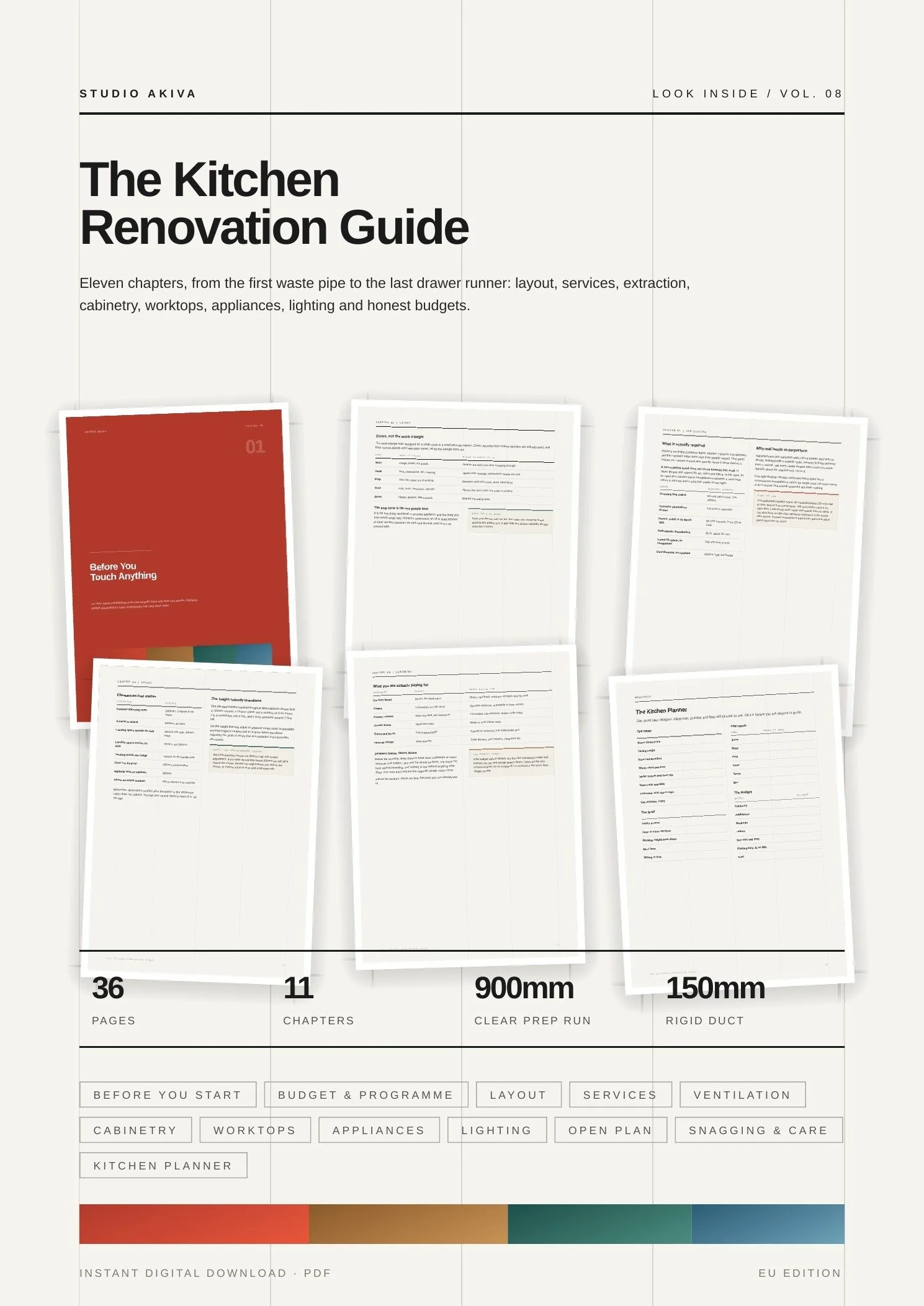
The Kitchen Renovation Guide is a 36-page illustrated handbook from award-winning studio Akiva. It follows the job in the order it actually happens, so you know what has to be decided before the plasterboard goes on.

It starts with the eight things to establish before you buy anything: where the waste runs, what the floor is made of, your water pressure, whether there is a duct route, whether your consumer unit has spare ways. Then budget and programme, with a stage-by-stage timeline and the reasons kitchens overrun.

The technical core is where this guide earns its place. Clearances in millimetres. Zones rather than the work triangle, which was designed for a 1940s kitchen and does not survive an island. Waste falls and flow rates. Why an induction hob needs its own high-current circuit.

And extraction explained properly, which is where most European guides go vague. There is no single European figure: Germany asks for 60 m³/h with a hood under DIN 1946-6, France between 45 and 135 depending on the size of the dwelling, the Netherlands 21 litres per second. The guide sets them side by side so you can find yours, and explains why a recirculating hood counts towards none of them.

Then the enjoyable part. What you are actually paying for in cabinetry, and why hinges and runners matter more than doors. Worktops compared by the linear metre on price, durability and heat. Appliances, and why choosing them after first fix is the most expensive ordering mistake in a kitchen. Lighting a room that is a workshop at seven in the morning and a dining room at eight at night.

EU edition: written around national extract rates, IEC 60364 and your member state's wiring rules, with costs anchored on German figures and prices in euros.

Every chapter ends in something you can act on, including a full snagging list and a printable Kitchen Planner your fitter, electrician and plumber will all want to see.

Format: PDF, 36 pages, A4. Instant download after purchase.

A kitchen is the largest single spend in most renovations, and almost none of what goes wrong is about taste. It is about the order things happen in, and about decisions taken too late to be free.

The Kitchen Renovation Guide is a 36-page illustrated handbook from award-winning studio Akiva. It follows the job in the order it actually happens, so you know what has to be decided before the plasterboard goes on.

It starts with the eight things to establish before you buy anything: where the waste runs, what the floor is made of, your water pressure, whether there is a duct route, whether your consumer unit has spare ways. Then budget and programme, with a stage-by-stage timeline and the reasons kitchens overrun.

The technical core is where this guide earns its place. Clearances in millimetres. Zones rather than the work triangle, which was designed for a 1940s kitchen and does not survive an island. Waste falls and flow rates. Why an induction hob needs its own high-current circuit.

And extraction explained properly, which is where most European guides go vague. There is no single European figure: Germany asks for 60 m³/h with a hood under DIN 1946-6, France between 45 and 135 depending on the size of the dwelling, the Netherlands 21 litres per second. The guide sets them side by side so you can find yours, and explains why a recirculating hood counts towards none of them.

Then the enjoyable part. What you are actually paying for in cabinetry, and why hinges and runners matter more than doors. Worktops compared by the linear metre on price, durability and heat. Appliances, and why choosing them after first fix is the most expensive ordering mistake in a kitchen. Lighting a room that is a workshop at seven in the morning and a dining room at eight at night.

EU edition: written around national extract rates, IEC 60364 and your member state's wiring rules, with costs anchored on German figures and prices in euros.

Every chapter ends in something you can act on, including a full snagging list and a printable Kitchen Planner your fitter, electrician and plumber will all want to see.

Format: PDF, 36 pages, A4. Instant download after purchase.

STUDIO AKIVA GUIDESVOLUME 08 / KITCHENS
SEQUENCE IT, THEN CHOOSE IT

The largest single spend in most renovations, and almost none of what goes wrong is about taste.

See the eleven chapters 11 CHAPTERS · 36 PAGES · A4 PDF
Why this guide01

Kitchens do not fail on the
building work. They fail on order.

Choosing appliances after first fix, booking the worktop template before the units are fixed, leaving extraction until second fix when the ducting needed a hole in the wall two stages earlier. Every one of those is a sequencing error, not a skill error, which is the quiet good news.

Written to real standards

Extract rates set out country by country, IEC 60364 and your national wiring rules, and the dedicated circuit an induction hob actually needs.

Numbers, not vibes

Clearances in millimetres, worktop prices per linear metre, realistic stage durations and the contingency that survives a strip out.

Honest about cost

Where the money genuinely goes across cabinetry, appliances, worktops and labour, with German figures as the anchor.

Checklists you can use

A full snagging list, an appliance schedule and a printable Kitchen Planner your fitter, electrician and plumber will all want.

36Pages
11Chapters
900mmClear prep run
120 m³/hOpen plan extract
What’s inside02
  1. 01Before You Touch AnythingThe eight things to establish first, from where the waste runs to whether your board has a spare way.
  2. 02The Budget and the ProgrammeWhere the money actually goes, realistic totals, and the stage timeline including the template gap.
  3. 03Layout and ClearancesZones rather than the work triangle, the clearances that matter, and setting worktop height from an elbow.
  4. 04Water, Waste, Power and GasFalls and flow rates, notifiable electrical work, the induction circuit, and the order services go in.
  5. 05Ventilation and ExtractionWhy there is no single European figure, the national rates side by side, and why a recirculating hood never counts.
  6. 06Cabinetry and StorageWhat you are paying for, why drawers beat cupboards, storage by reach, and the five things to solve properly.
  7. 07Worktops and SurfacesFive materials compared per linear metre on price, durability and heat, and why heat is the dividing line.
  8. 08AppliancesDecisions in the right order, induction against gas honestly, and the one people regret undersizing.
  9. 09Lighting a Working RoomFour layers, why downlights in a row put you in your own shadow, and the numbers to specify.
  10. 10Small Kitchens and Open PlanProtecting the prep run, and the noise, smell and sightline problems open plan actually creates.
  11. 11Snagging, Care and What Fails FirstThe sign off list, the handover pack to insist on, and a maintenance schedule by component.
Choose your edition03

The EU edition

This edition sets out kitchen extract country by country, from Germany’s DIN 1946-6 to the French arrêté of 1982 and the Dutch Bouwbesluit, prices worktops by the linear metre and quotes in euros. A UK edition citing Approved Document F, Part P and BS 7671 is on our UK site.

Add to basket using the button at the top of this page. Your download link arrives by email straight after checkout.

Questions04
What format is it?

A 36-page A4 PDF. Your download link arrives by email straight after checkout, and you can read it on any device or print it at home.

Which country is it written for?

All of them, and none of them exclusively. Kitchen extract, wiring and gas rules are national rather than European, so the guide sets the main markets out side by side and tells you to confirm your own. Costs are anchored on German figures because that is where our European studio is, and the shape holds across the continent.
Is it useful if I am not moving the