 Image 1 of 2
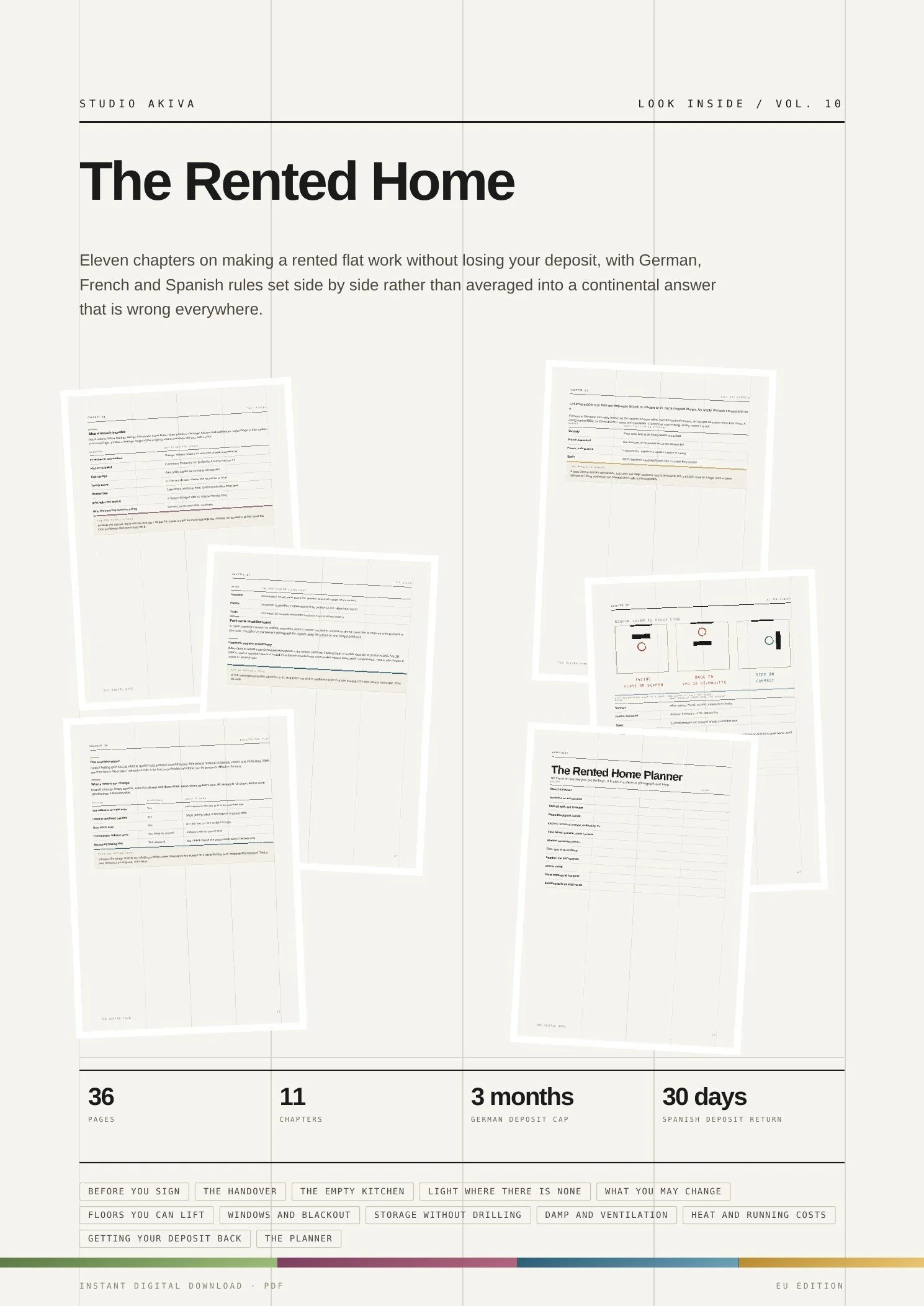 Image 2 of 2
Making a flat you do not own work properly, and getting your deposit back at the end of it.
Most advice about homes
assumes you own one.
Almost none of it survives a rented flat in Berlin, Paris or Madrid, where what you are given, what you may change and what you must put back are all decided by somebody else, and decided differently in each country. This guide starts before you sign, because that is where most of the expensive decisions are made, and ends with the deposit, because that is where they are paid for.
Three markets, not an average
Germany, France and Spain set side by side on deposits, inventories, alterations and what the landlord must provide, because an average would be wrong everywhere.
The empty flat, solved
No kitchen, bare ceiling cables, no rail at the window. What to buy, what to leave, and what it costs to put right without touching the building.
Every rule named
§ 551 BGB, the loi of 6 July 1989, LAU article 36 and the 2015 Federal Court of Justice ruling on cosmetic repairs, named so you can look them up.
A planner for handover day
A record to fill in the day you get the keys, and a four-week countdown to handing them back with a filled hole and a clean oven.
- 01Before You SignWhat is actually included, what the outgoing tenant is selling, and the survey to walk with a tape and a torch before you commit.
- 02The HandoverÜbergabeprotokoll, état des lieux, inventario: the document that decides your deposit, and the twenty minutes of photographs that protect it.
- 03The Empty KitchenWhy German flats are let with no kitchen at all, what a basic one costs to fit, and the connection heights to measure first.
- 04Light Where There Is NoneBare ceiling cables and too few sockets. Four layers of light that need no electrician, and the one job that does.
- 05What You May ChangePaint, holes and fixings in each market, and the 2015 ruling that means you may owe less than your lease says.
- 06Floors You Can LiftRugs, loose-lay planks and tiles, which are genuinely reversible, and how to protect the floor underneath.
- 07Windows, Privacy and BlackoutWhat comes with the window in each country, and no-drill fixings that actually hold.
- 08Storage Without DrillingFreestanding, floor to ceiling and reversible, with the useful depth for every room and the one screw worth using.
- 09Damp, Mould and VentilationThe most common deposit dispute in Europe, what German courts have held you can be asked to do, and how to prove you did it.
- 10Heat, Cold and Running CostsWhy a flat in Madrid can be colder in February than one in Hamburg, and the reversible fixes a tenant can make.
- 11Getting Your Deposit BackKaution, dépôt de garantie and fianza side by side: caps, legal basis, who holds it and how long it takes.
- +The Rented Home PlannerA handover record to fill in on the day you get the keys, and a four-week countdown to handing them back.
Written for renting in Europe,
not adapted for it.
Tenancy law is national, and the same transaction works differently in each country. This guide is built on the German Kaution under § 551 BGB, the French dépôt de garantie under the loi of 6 July 1989 and the statutory list of eleven items a furnished let must contain, the Spanish fianza under LAU article 36, the French energy rating letting bans, and German case law on cosmetic repairs and ventilation. Where a single European answer does not exist, the three main markets are set side by side rather than averaged. Prices in euros.
Add to basket using the button at the top of this page. Your download link arrives by email straight after checkout.
What format is it?
A 36-page A4 PDF. Your download link arrives by email straight after checkout, and you can read it on any device or print the planner pages at home.
Which country is it written for?
Germany, France and Spain, set side by side. Deposits, inventories, what a landlord must provide and what you may change are all national rules, so where they differ the guide shows all three rather than inventing a European average. If you rent elsewhere in Europe, the practical chapters still apply; check the legal points against your own country.
Is this legal advice?
No. Studio Akiva are interior designers, not lawyers. Every rule in the guide is named so you can look it up, and where a dispute is genuinely live it sends you to the people who handle them every day: a Mieterverein in Germany, an ADIL in France, or a municipal housing advice office in Spain.
I have already moved in. Is it too late?
No. Chapters 3 to 10 are about living in the flat, and chapter 11 is the one to reread before you hand the keys back. If you did not photograph the flat at handover, start the record today: a dated set of photographs from month three is still far better than none.
Is it only for people moving from abroad?
It is written with the new arrival in mind, because that is who is most often caught out, but nothing in it depends on where you came from. Anyone renting in Germany, France or Spain will find the deposit and handover chapters useful.
Can I cancel or get a refund?
This is digital content supplied immediately. At the point of purchase you expressly consent to us beginning supply before the end of the withdrawal period and acknowledge that your 14 day right of withdrawal ends once the download link is issued. The full notice is at studioakiva.eu/widerrufsbelehrung. Separately from that: if the link fails, the file will not open, or you received the wrong guide, email hello@studioakiva.com and we will put it right or refund you.
Would you rather we did it?
Studio Akiva is an award-winning interior design studio working across Europe and a twelve-time Houzz award winner. If you would rather talk a flat through before you commit to it, book a free fifteen-minute discovery call.