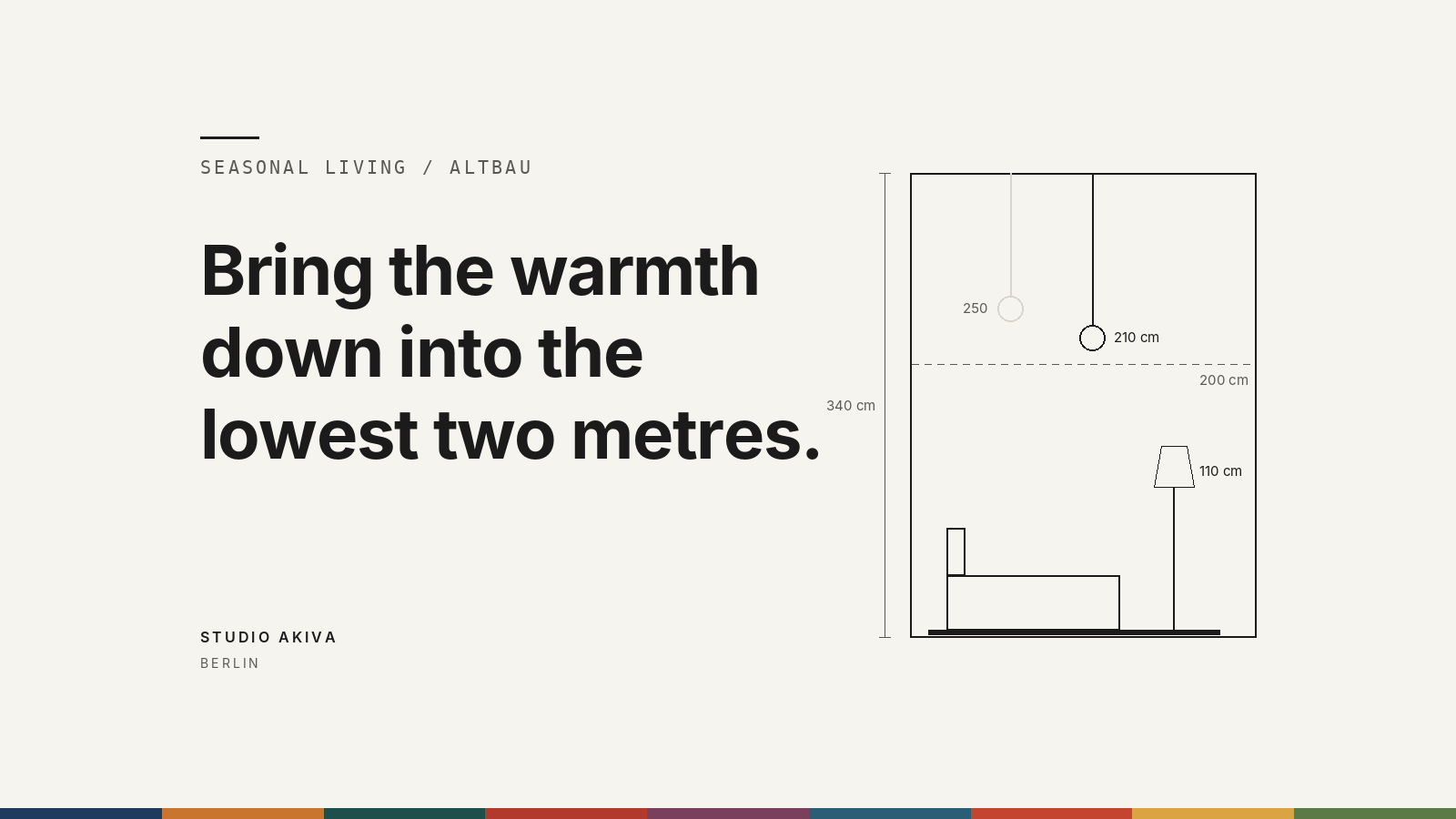
A Berlin Altbau feels warm in winter when the light, the textiles and the seating are brought down into the lowest two metres of the room. Use 2700 K lamps at three heights, a rug that covers most of the seating area, lined curtains that never hang over a radiator, and keep large furniture 5 to 10 cm off the external walls.
None of that changes the temperature on the thermostat. It changes what you see, what you touch and where the heat goes once it leaves the radiator, and in a room with a 3.5 metre ceiling those three things decide whether an evening feels comfortable.
Why does an Altbau feel colder than the thermostat says?
Three things work against you. Warm air rises, so in a room 3.4 or 3.5 metres high a good share of the heat you pay for collects above head height while your feet sit in the coolest layer. The surfaces around you are cold: solid external walls, tall box windows and bare timber floors all draw warmth from your body even when the air temperature reads 20 degrees. And the room is usually lit from one pendant near the ceiling, which throws flat light over a large volume and makes it look as cool as it feels.
A designer cannot insulate the building, and the windows, the heating system and the walls belong to the owner or the Hausverwaltung. What we can change is everything in the room that sits between you and those cold surfaces. That is usually enough to turn a room people avoid in January into one they use.
How should you light a room with a 3.5 metre ceiling?
Bring the light down. A ceiling rose with a pendant on a one metre cable leaves the lamp about 2.5 metres above the floor, which lights the top of the room well and the sofa badly. Lengthen the cable so the pendant hangs around 210 cm above the floor in a living room, or 75 cm above the table top in a dining room.
Then add light where people sit. In a living room of about 25 square metres we would plan five to seven sources: table lamps with the shade at seated eye level, roughly 110 cm from the floor, a floor lamp beside the reading chair, and one low source on a sideboard or shelf. Keep every lamp at 2700 K. Mixing 2700 K and 4000 K in one room is the most common reason an Altbau looks grey at night.
Dimmers matter more than wattage. If the wiring or the tenancy rules out new wall dimmers, plug-in dimmers and dimmable LED lamps do the same job without touching the installation. Our lighting distribution service covers this room by room.
Which rugs and curtains make the biggest difference?
Start with the floor. Old Dielen and parquet have gaps, and the floor is the coldest surface you touch. A rug should be large enough that the front legs of every seat rest on it, with a felt underlay of about 8 mm beneath. In most Altbau living rooms that means 200 by 300 cm at the least, and often 250 by 350 cm. A small rug floating in the middle of the room does almost nothing.
Curtains come second, and they need thought because of where the radiators are. In most Berlin flats the radiator sits directly under the window. A floor-length curtain drawn across it sends the heat up behind the fabric and against the glass. Where that is the case, fit a lined blind inside the window reveal that stops above the radiator, and treat any full-length curtains as side panels that are never drawn across it. Where the radiator is on another wall, full-length lined curtains drawn at dusk are the single most effective textile in the room.
Where should furniture go so the heating can work?
Keep at least 30 cm clear in front of every radiator. A sofa pushed against one absorbs the heat and leaves the rest of the room cold. Move the seating towards the centre of the room or onto an internal wall, which also takes you away from the coldest surfaces.
Wardrobes, bookcases and beds need a gap of 5 to 10 cm from any external wall so air can move behind them. Without it the wall stays cold and damp behind the furniture, and that is where Schimmel starts in winter. This is worth getting right in a rented flat, because mould behind furniture is usually argued to be the tenant's responsibility.
Our guide The Rented Home goes through what a tenant can change without asking and what needs the landlord's agreement.
Which colours help in winter light?
Berlin gets under eight hours of daylight in December, and much of it is grey. Brilliant white walls turn blue-grey in that light. A warm white or a soft neutral with a little yellow or red in it holds its colour through the afternoon and looks right under 2700 K lamps in the evening.
Height can be managed too. Taking the wall colour up to about 240 cm and painting everything above it, ceiling included, in a lighter shade lowers the point where the eye rests, so the room reads as a comfortable height without losing the plasterwork. Keep pictures, shelves and mirrors below that line for the same reason. Whether a darker colour works depends on the room: it suits a street-facing room with two large windows and rarely suits a courtyard room on a lower floor.
A worked example: a 4.5 by 5.5 metre living room
Take a typical front room: 450 cm wide, 550 cm long, 340 cm high, with two box windows on the short street wall and a radiator under each.
The sofa, 240 cm long and 95 cm deep, goes on the long internal wall and starts 100 cm from the window wall. That keeps both radiators clear and leaves 210 cm beyond the sofa for a desk or a dining table (100 + 240 + 210 = 550 cm). Across the width, the sofa takes 95 cm, then 45 cm to a coffee table 60 cm deep, 45 cm to two armchairs 80 cm deep, and a 90 cm walkway behind them along a 35 cm sideboard (95 + 45 + 60 + 45 + 80 + 90 + 35 = 450 cm).
A 250 by 350 cm rug sits under the whole group. The pendant drops to 210 cm, and six lamps sit below 160 cm: two beside the sofa, one floor lamp, one on the sideboard, one on the desk and one picture light. Each window has a lined blind inside the reveal, with side panels that stay open.
You can see the same proportions in our Olivaer Platz project, a family flat in a historic Wilmersdorf building with tall windows, high ceilings, original plasterwork and parquet.
Where the popular advice fails
"Paint it dark to make it cosy" fails in a room that gets little daylight, where a dark wall simply looks unlit for five months. "Hang heavy curtains" fails when the radiator is under the window. "Push the furniture back to make space" puts the sofa on the coldest wall and often in front of the heating.
There are limits as well. If a room is cold because the windows leak or the heating is undersized, furnishing will improve it but will not fix it, and that conversation belongs with the landlord or the Hausverwaltung. Where a project touches the building itself, we work alongside the owner's own engineer or can introduce a trusted partner.
Studio Akiva has over 100 five-star reviews on Houzz, has been a Houzz member since 2017 and has won twelve consecutive Houzz awards, with residential projects completed in the UK, USA, Dubai and Saudi Arabia.
Quick answers
What colour temperature is best for a living room in winter?
2700 K. It is the warm white closest to a traditional bulb. Use the same value in every lamp in the room, and choose dimmable lamps so the level can drop in the evening.
Should curtains cover a radiator?
No. A curtain drawn over a radiator directs the heat to the window. Use a blind inside the reveal that ends above the radiator, or curtains that stop at the sill.
How far should furniture be from an external wall?
Leave 5 to 10 cm behind wardrobes, bookcases and beds so air can circulate. Keep 30 cm clear in front of radiators.
How big should a rug be in an Altbau living room?
Large enough for the front legs of every seat to rest on it. For most rooms that is 200 by 300 cm or 250 by 350 cm.
Do high ceilings make a room harder to heat?
Yes. Warm air collects at the top of the room, so the lower part where you sit stays cooler. Lighting, rugs and furniture placement do not change that, but they change how the room feels.
Want a second opinion on your Altbau?
Our designers are based in Berlin and work in English. In an hourly interior design consultancy session we look at your floor plan and photos, and you leave with a furniture layout, a lighting plan and a list of what to buy, in the order to buy it.