In a Berlin Altbau flat you can usually change what you see and touch: paint, floor finishes, lighting, joinery, kitchen and bathroom fittings, and how each room is used. What sits inside the building is different. Walls, openings, windows, chimney breasts and anything in a listed building depend on the structure, the owners' association and the heritage authority, so ask before you plan around them.
That split matters more in an Altbau than in a newer building, because the rooms were proportioned around 3 to 3.5 metre ceilings, double doors and a chimney breast. The flat gives you more to work with than it first appears, if you design with it rather than against it.
What can you change without asking anyone?
If you own the flat, most of the surface is yours to decide. That covers wall and ceiling colour, lighting, curtains, rugs, freestanding furniture, and how you assign rooms. Fitted joinery inside a room, such as shelving or a wardrobe built into an alcove, is normally part of the same decision, provided it does not touch the building structure.
If you rent, the line is the landlord's written consent. Anything fixed, drilled in volume or hard to reverse needs it. Lamps, rugs, freestanding shelving and furniture do not.
The cheapest change with the largest effect is almost always the use of the rooms. The largest room does not have to be the living room, and the room you call the bedroom may suit working better.
Which parts of an Altbau are worth keeping?
Four features are difficult to replace and easy to lose: the original floorboards, box windows with two layers of glazing, plaster mouldings on the ceiling, and tall double doors between rooms. They give an Altbau its proportions, and they are the details that a new-build flat cannot copy.
We design around them. Boards can be sanded and finished, doors can be refitted so they close properly, and a ceiling moulding sets the height where fitted storage should stop. A chimney breast is not always working, but it is a ready-made frame for shelving on either side.
Whether a particular feature is protected is a question for the building authority and your owners' association. We do not give legal advice, and we would rather you asked before the order is placed.
What needs permission or an engineer first?
Four things: any wall, any new opening between rooms, anything on the street side of the building, and anything in a listed building.
Windows and the front of the building are often common property, shared among all owners, not something you can change alone. An internal wall may be structural, and the only way to know is the building drawings and a structural engineer. In a listed building, the heritage authority has a say in changes you might consider cosmetic.
The sensible order is to ask the Hausverwaltung what has already been approved, ask an engineer about the wall, and only then draw the layout. We do not give structural or legal advice. Where a project touches the building itself, we work alongside the owner's own engineer or can introduce a trusted partner.
How do you make an Altbau layout work without moving walls?
Start with what the plan already gives you. A Berliner Zimmer, the room that links the front and rear parts of the flat, often has only one window and works well as a dining room, a library or a second bedroom. Double doors between two rooms can stay open for light and close for privacy, which gives most of an open-plan flat's benefit with none of its cost.
Then use the height. A 3.4 metre ceiling lets you take storage to 3 metres, which is 25 per cent more vertical space than a freestanding wardrobe of 2.4 metres. Keep the moulding clear of the top and the cupboards look as if they belong.
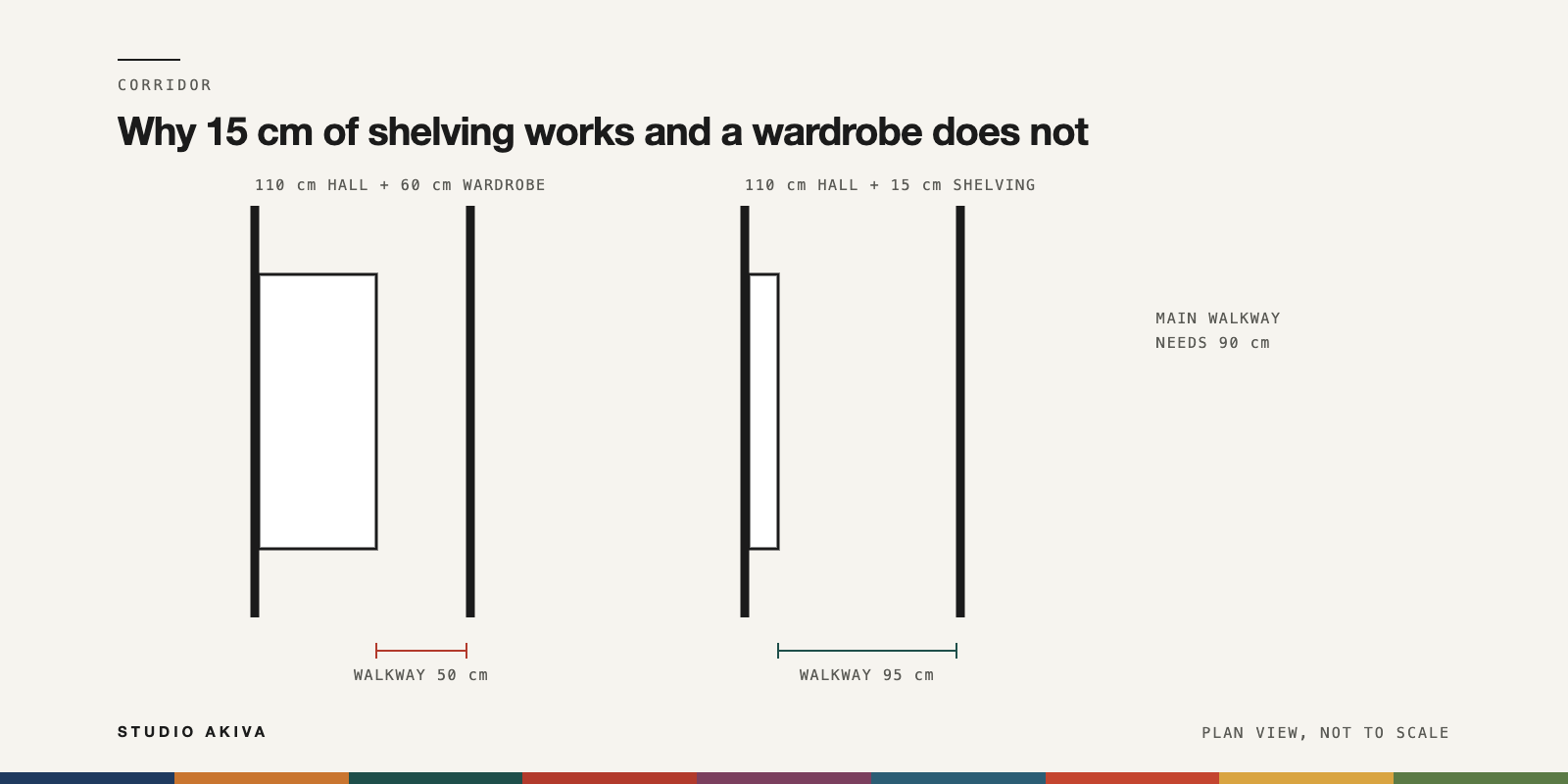
Finally, look at the corridor. A hall of 110 cm cannot take a 60 cm deep wardrobe and still leave a 90 cm walkway, but it can take shelving 15 cm deep and still leave 95 cm, and that is often enough for coats, keys and books.
For how the same rooms behave once the heating goes on, see how to make a Berlin Altbau feel warm in winter.
What about curtains in a room this tall?
Standard curtains are cut for ceilings of about 2.4 to 2.6 metres, so on 3.4 metres they stop short. Hang a 250 cm curtain from a pole at 320 cm and it ends 70 cm above the floor. Most German windows also open inwards, so a blind fitted inside the reveal fouls the sash.
Hang a track high, at or just below the moulding and wider than the window, outside the reveal, and have the curtain made to length. For a window 140 cm wide, a track of about 200 cm leaves 30 cm each side for the curtain to stack back off the glass.
A worked example: a bedroom with a chimney breast
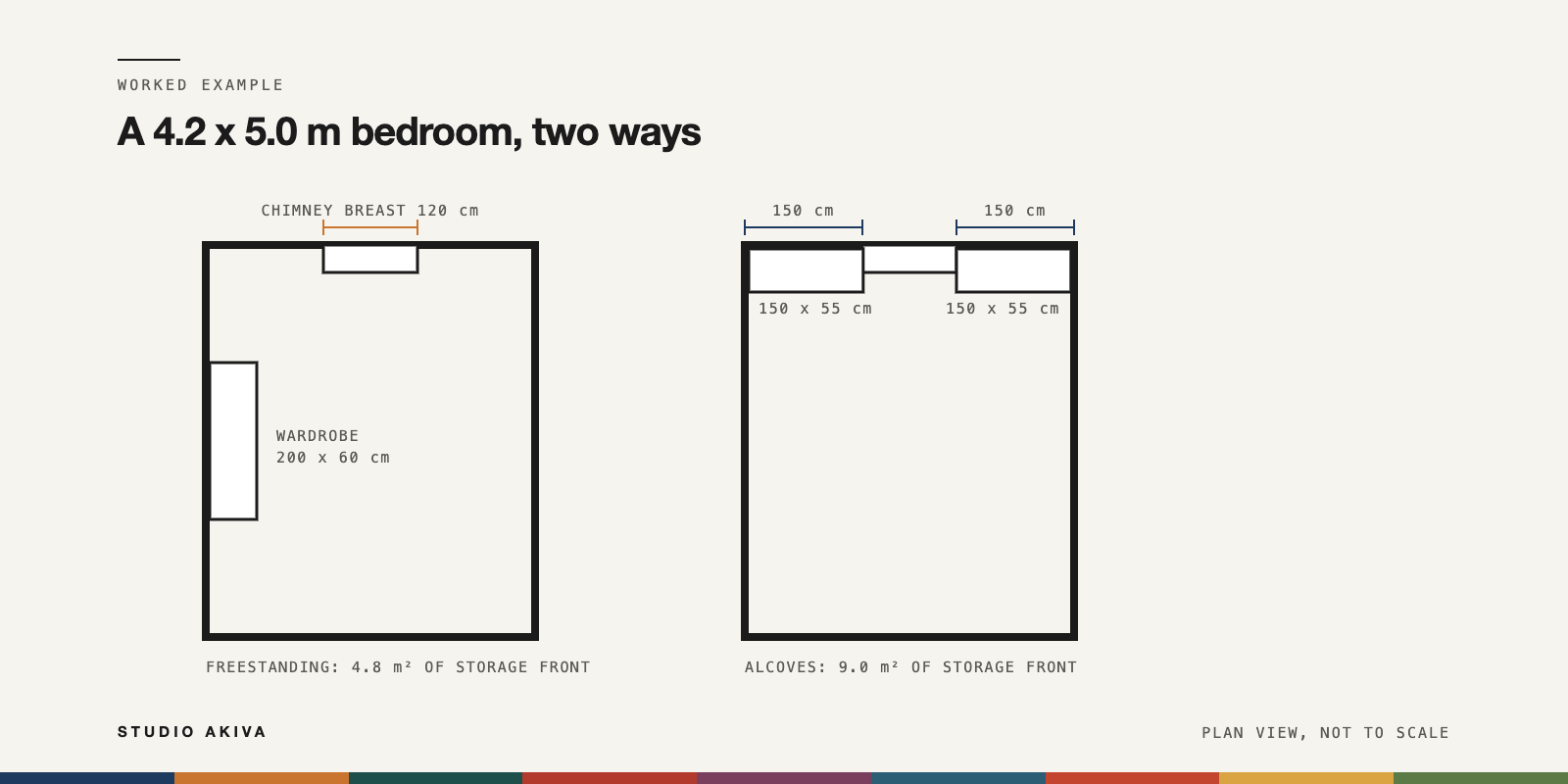
Take a bedroom of 4.2 by 5.0 metres with a 3.4 metre ceiling. A chimney breast projects 35 cm into the room on one 4.2 metre wall, is 120 cm wide and sits in the centre. That leaves an alcove 150 cm wide on each side, since (420 - 120) / 2 = 150.
A freestanding wardrobe 200 cm wide and 240 cm high gives 200 x 240 = 48,000 cm², or 4.8 m² of storage front, and it stands 60 cm into the room.
Fit a cupboard 55 cm deep into each alcove, 150 cm wide and 300 cm high, and the two fronts add up to 300 x 300 = 90,000 cm², or 9.0 m². The depth is enough for hanging rails, and the cupboards stand only 20 cm beyond the chimney breast. The storage nearly doubles, from 4.8 to 9.0 m², and the cupboards take no more floor than the wardrobe did, 55 cm from the wall instead of 60, because they sit in space the room was not using.
None of that touches a wall, a pipe or a window.
Where the popular advice fails
The advice to knock through and open the space ignores what the wall was doing. In an Altbau it often carries the radiator, the only free run for a sofa, and a door frame that gives the room its proportion. Removing it can leave one large room that is harder to heat and harder to furnish than the two before.
The expensive mistake is pricing the wall before checking whether it can come out. By the time the answer is no, the layout, the kitchen position and sometimes the offer have been built around a yes.
The second piece of popular advice is to replace the old windows first. Box windows are often repairable and are often common property, so the question is who decides, not what looks best on a mood board.
Studio Akiva has over 100 five-star reviews on Houzz, has been a Houzz member since 2017 and has won twelve consecutive Houzz awards, with residential projects completed in the UK, USA, Dubai and Saudi Arabia.
Quick answers
Can you remove a wall in a Berlin Altbau flat?
Only if it is not structural, and a plan cannot show that. You also need the owners' association's agreement if you own the flat. Ask for the building drawings and an engineer's view first.
What is a Berliner Zimmer?
The corner room that links the front and rear parts of an Altbau flat. It usually has a single window, so it suits dining, reading or a second bedroom better than a main bedroom.
Can tenants change an Altbau flat?
Fixed changes need the landlord's written consent. Lamps, rugs, freestanding shelving and furniture do not, and they change the feel of a room more than most people expect.
Do double doors have to stay?
Not always, but they are hard to replace once removed. They give light and privacy in one fitting, so we try to keep them before looking at a wall.
Want a second opinion on your Altbau plan?
Send us the Grundriss before we speak. In the Layout Clinic we spend ninety minutes on video, in English, working through the layout with you, and you get our reasoning in writing within 48 hours. If you are still deciding whether to buy, start with what to check on a floor plan before buying a Berlin flat.
Featured photo: Julia (beazy) on Unsplash.